SummerInItaly.com


|
|
|
|
|
|
     
The Spanish Steps

The Spanish Steps

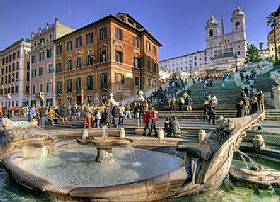
Piazza di Spagna, the Spanish Steps, has been for ages the stopping and arrival point of horse-carts that, coming from Porta del Popolo (the northern gate of the city) carried the foreigners downtown.

It is now an incredible, almost theatrical square and international meeting point in Rome, famous for the lovely 135 Spanish Steps (Scalinata di Trinità dei Monti). The staircase, which was inaugurated in 1725 (Jubilee Year) by Pope Benedict XIII, was originally used to link the Bourbon Spanish Embassy to the Church of Trinità dei Monti. The name derives indeed from the Spanish Embassy (since 1647) to the Holy See that was – and is - located in the southern side of the piazza.

The Spanish diplomats decided to renovate the building in 1653. Antonio Del Grande was charged with the project and probably made use of some drawings previously realized by Borromini. The façade got embellished at the level of piano nobile with two ligneous balconies, holding five windows on the left and three on the right. However the interiors were most significantly renewed: it was built a larger lobby with vaults supported by twin columns; the great staircase with a balustrade; the courtyard with lovely arcade closed by large windows, alternated by square pillars, showing the Spanish king's coat of arms on the capitals.

The short French domination of Rome required the temporary occupation of the building from the Napoleonic troops. During that period, the edifice underwent a radical renewing of the façade due to the work of the Spanish architect Antonio Celles: no more balconies and penultimate floor's windows, while the other windows were changed.

There was another important change in 1898: the main entrance staircase was decorated with a gorgeous fresco representing the The Delivery of the Keys of Granada, made by A. Ballester. In 1932, the edifice had the last renovation work, marked by a central balcony holding three windows.

In front of the building, it rises the Column of the Immaculate Conception, deeply wanted by Pope Pius IX in 1857, to commemorate the Immaculate Conception's dogma, defined three years earlier. The impressive work of art was made by the architect Luigi Paoletto, who designed a complex monument: big polychromatic marble base, "animated" by steps, seats, four statues representing Moses, David, Isaiah, Ezekiel; four bas-relieves depicting the Definition of the Dogma, St Joseph Dream, the Coronation of Mary and the Annunciation.

The other original building of the piazza is the College Of Propaganda Fide, erected by Bernini and terminated by Borromini. The College, which had the purpose to train Catholic Missionaries to spread out the faith around the world, was instituted by Pope Urban VIII in 1626 (the building is also known indeed as Collegio Urbano). The façade is characterized by square pillars, isolating vertically four series of windows; there is an ashlar-work portal with triangular tympanum, surmounted by a huge plaque with the following Latin inscription COLLEGIUM URBANUM DE PROPAGANDA FIDE. The latter is crowned by the Barberini's coat of arms belonging to Urban VIII between two swags.

The Oratory of the Three Kings – built by Bernini in 1633, but later demolished and remade as it currently is by Borromini (Italian, Oratorio dei Re Magi) - is annexed to the College. It is a marvellous stuccoed hall, with diagonal stripes that divide the ceiling into lozenges.

The fountain known as the 'Barcaccia' (boat), at the foot of the staircase, was commissioned by Urbano Barberini to commemorate the alliance made with the King of France, whose coat of arms can be seen on Trinità dei Monti. The fountain was realized by Pietro Bernini, Gian Lorenzo's father, while his son made the side decorations. The name only apparently depreciative (Italian "barcaccia" is pejorative of "barca", ship) derives from the ships used to carry the wine from the nearby port of Ripetta. The fountain symbolizes the ingeniousness of Bernini's oeuvres: a ship than seems to sink, so made to avoid the problem of low hydrostatic pressure of the fountain. The bees and the suns decorating the fountain are the symbols of Urban VIII's family, the Barberini.

The building on the right side of the Spanish Steps, called "Casina Rossa", belonged to the lady Anna Angeletti, that used to rent rooms of her big house. The English poet Keats stayed there with his friend, the painter Joseph Severn, and both were incredibly enthusiastic of that place. In 1906 the building was bought by Keats-Shelley Memorial House with the noble intention of making a literary temple in honour of the Romantic English poets. The edifice was restored and set as library and museum: it has been open to the public in 1909. The opposite side of the staircase exhibits the twin building, that strictly repeats the structural and decorative elements of the Casina Rossa.

The basement homes the Babington's tearoom, founded in 1893 for want of two enterprising English ladies, Miss Babington e Miss Cargill. They had been able (investing the total amounts to a hundred pounds) to create one of the most renowned tearooms in town and to spread the "tea culture" in Rome.

At Christmas an evocative crib is erected halfway up; in spring the steps are adorned with huge tubs of azaleas and one of the most important fashion shows is held here, the steps being used as a catwalk.

You will never forget it!

  • Address: Piazza di Spagna, Rome.

You might also be interested in reading about the following topics...

Tourist Attractions in Rome, Rome


Bookmark and Share

Search Villas

Quick search:

Sleeps:

Min bedrooms:

From (optional):

For week(s):

Sort:

Property name:

Advanced search

(swimming pool, air conditioning, view of the sea and other amenities...)

Browse Villas

Amalfi Coast
Sorrento Coast
Tuscany
Cilento National Park
Lake Como
Rome and Latium
Umbria
Capri and Ischia
Venice
Puglia (Apulia)

Browse by town

Deals and last minute
New villas
Large groups
Luxury villas
Romantic villas

How to rent

Booking on-line is easy: here is how it works and what happens after you have made your reservation.

Testimonials

Our greatest reward is your satisfaction! See what our guests think of us...

F.A.Q.

Read the answers to the most frequently asked questions on renting an apartment or a villa with us.

Let's talk

We would like to help you in choosing the best accommodation for your vacation in Italy.

About us

Learn more about us and see how we got started.

Why us?

Here are ten good reasons to book your Italian villa with us.

Terms

Read the rental terms for our properties.


Subscribe to our free newsletter to be informed of news and updates and to receive useful travel tips.

E-mail address:


Travel Guide Home

Your recently visited:


*The Spanish Steps
*Campione d'Italia
*Conca dei Marini
*Rosignano Solvay
*Greve in Chianti
*Cilento Explorer
*Churches in Perugia
*Meta di Sorrento
*Beaches in Anacapri
*Ogliastro Marina
*Itineraries in Pisa
*Hosteria Il Pino
*Chianciano Terme
*Beaches in Positano
*Restaurants in Rome
*Caves of Pertosa
*Beaches in Agropoli
*Vittorio Pironti
*Mezzatorre Beach
*Fontana di Trevi

Home | Travel Guide | Travel Tips | Contact Us

USA & Canada Toll Free: 1 800 509 8194
UK Toll Free: 0 800 047 0248
International: +41 91 220 0567
Italy: +39 089 842 6126. Switzerland: +41 91 220 0567

Fax International: +41 91 220 0877. Fax Italy: +39 089 311 5055. Fax USA & Canada Toll Free: 1 888 883 7172
Email: info@summerinitaly.com

All kind of questions and suggestions are welcome: info@summerinitaly.com. Copyright © 2001-2012 Summer In Italy. All rights reserved.

USA & Canada Toll Free: 1 800 509 8194
UK Toll Free: 0 800 047 0248
International: +41 91 220 0567
Italy: +39 089 842 6126
Email: info@summerinitaly.com