SummerInItaly.com


|
|
|
|
|
|
     
Cortona

Cortona

by Loretta Gallorini

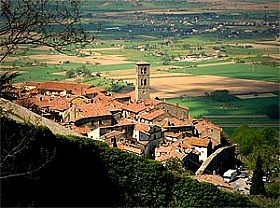
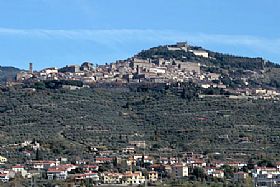
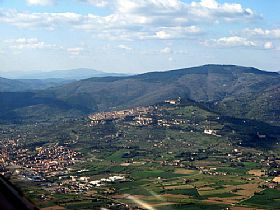
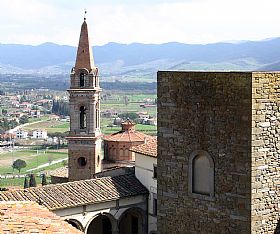
Above on a high hill in Tuscany, fifty miles from distant Fiorenza, between Arezzo and Perugia, it rises proud and not less ancient that noble city of Cortona. This way Cortona was described in a 1639 tourist guide. At a distance of more than four hundred years, really few things have changed. The city, in fact, has been able to maintain the aspect and the atmosphere of the medieval town in spite of time, lying on the slopes of the Sant’Egidio mountain with its characteristic fan-shaped structure it is surrounded by mighty walls and it almost dominates the whole Valdichiana as far as the banks of the lake Trasimeno.

Reaching Cortona from the bottom of the valley, is a way to appreciate its urban scheme on the mountainous slope that divides the Valdichiana from the Valle del Tevere. Immediately the contour of the walls stands out, it is three kilometres long and it ends into the fortress of the Girifalco, and the compactness of its urban centre is also evident. One glimpse is enough to understand the importance of the role that the city has had since the Etruscan age, also in relationship to the other centres of the valley.

To visit Cortona means to take a trip through the centuries. A visit to the historical centre of Cortona can start from Via Nazionale, or as the Cortonesi call it, from Rugapiana being the only level road, having left the car in one of the so many parking lot near piazza Garibaldi.

From Via Nazionale lots of roads start climbing or going down through the ancient town and there are numerous beautiful shops of artists, artisans and of typical products of the territory. Along the road stand beautiful palaces in Renaissance style such as Palazzo Ferretti Mancini or as Palazzo Venuti.

As you have gone the whole road, you arrive in Piazza of the Republic, centre of the politics business, since the Roman age, here rose the Forum, even today the beating heart of the city life. On the square it leans out the Palazzo del Consiglio Comunale (Palace of the Board) of XII century, built after the constitution of the free Commune to house the reunions of the maximum city meeting. The building has suffered many amplifications and restorations in various ages until to purchase the present look. In origin it was formed by an only great room, widened during 1500 and endowed with a bell tower. In the Room of the Board is a stone fireplace by Cristofanello.

Just in front of the Palazzo del Consiglio Comunale the Palazzo of the Captain of People of XIII century rises. It was erected during the age of the Commune in order to entertain the Captain of People, and when the city passed under the dominion of Florence it was given to the family Passerini.

Adjoining Piazza of the Republic, Piazza Signorelli is there almost to constitute an only great Renaissance lounge. Palazzo Casali, or the building of the Culture, leans out on Piazza Signorelli; such building is the seat of the Etruscan Academy, of the Museum of the Etruscan Academy and of the Town Library as well as of the Town Historical Archives. The building rises on the same area where old Etruscan and Roman constructions are. During the high Middle Ages the abbot of Farneta built here some houses that were the residence of the Consul. The Casali became the Rulers of Cortona in 1300 acquiring the ownership of the houses and they built their palace.

The present aspect of the palace is a work by Filippo Berrettini who restructured and widened it between 1613 and 1621 according to the Florentine administration. Numerous stone coats of arms of the Florentine administrators are on the right external wall of the palace.

On a light slope, always in Piazza Signorelli, stands the Theater Signorelli with its Loggia with seven arcades ending in vaults with lunettes. From always it offers a high cultural activity whether in winter or in summer.

At few metres of distance from piazza Signorelli is piazza of the Cathedral, centre of the religious life of Cortona since the Middle Ages. After having admired the splendid panorama that you can enjoy from the balcony of the square, your attention is caught by the Church of Saint Maria Assunta or Cathedral, principal city temple.

It rises on the ruins, still visible next to the portal, of an ancient church dating back even to the IV century b.C. In its present form it was built during the 1400 according to the project of Giuliano from St. Gallo, while the bell tower was raised in 1566 using a sketch by Francesco Laparelli, architect from Cortona that planned the city of the Valletta in the island of Malta and the defensive structures of the Castel Sant’Angelo in Rome.

The inside, notably modified during the XVIII century, houses a lot of works of art, among which an interesting Nativity ascribed to Pietro da Cortona, paintings by Cigoli, Allori, by Berrettini and by the school of Signorelli. On the square also the Episcopalian Palace and the Diocesan Museum of Sacred Art lean out. The Episcopalian Palace rises where the first house of Monk Elia in Cortona was: that’s what the tradition states.

The Diocesan Museum is placed in the complex of the Jesus. The museum picks up works of art that go from the II century b.C. to the modern period, among which works by Signorelli, by Beato Angelico, by Lorenzetti and by Margaritone.

Once finished the visit to the museum the walk can continue dipping in the magic quiet of the alleys that untie as far as the feet of the Cathedral. A medieval atmosphere is gathered around the characteristic houses of Via Iannelli: they date back to 1300, with the inferior part built with stones, while the upper section, leaning toward the road, is made of bricks.

Houses showing their medieval typology can also be found again in Via St. Mark, Via Benedetti and in Via Ghibellina. At the end of Via Ghibellina is the perhaps best preserved door of the old walls: Porta Ghibellina or Bacarelli: it is a mullioned door with two lights of the VII century b.C. and it continues with the best preserved part of the ancient Etruscan walls, some remains of which are today still visible from the base of the medieval walls, that currently surround the city.

You coast along the walls up to Porta Guelfa and, going the homonym street, go up again for reaching again the centre of the city. Here it deserves a standstill the conventual complex of Sant’Agostino, today congresses centre, and a look at the beautiful buildings among which Palazzo Baldelli, Palazzo Cristofanello-Laparelli and Palazzo Petrella.

As you reach piazza Signorelli you find several refreshments bars. Refreshed, you go up again toward the high part of the city, you go Via Maffei and you reach the church of St. Francis, built by Monk Elia. The church preserves its Gothic imprint, even if it was rehandled in the XVII century, its imposing massive structure and its original lines. In the inside the grave of Monk Elia, the one of Signorelli, numerous relics of St. Francis and works of art by Pietro da Cortona, by Cigoli and by Commodi.

Continuing your walk you reach Piazza of the Pescaia and visit the church of Sant’Antonio, the Convent of Saint Chiara, the church of St. Cristoforo and the church of St. Niccolò. The Church of St. Niccolò dates back to the XV century, it has an elegant portico on the façade. St. Bernardino from Siena founded here in 1440 the Company of St. Niccolò and as a memory of this, Signorelli painted the standard here preserved in the high altar.

On the front the standard shows the Deposition of Christ, while on the back part the Madonna with Child on Throne, also a fresco by Signorelli, representing the Virgo with Child, is present on the left wall.

The Convent of Saint Chiara was built in the XVI century according to the sketch of the Vasari, very suggestive the church with the high altar in graven and gilded wood, work by Fabbrucci, interesting is also the presence of works of Berrettini and Commodi.

The church of St. Cristoforo, is in an enchanting position, in Romanesque style with bell tower dating back again to the XIII century, it preserves in the internal part a cycle of frescos from the Umbrian school.

The church of Sant’Antonio dates again to the XIV century, it rises near the so called Bacchus’ Bath, reservoir of water of Roman epoch, of which the rests can still be seen in the Via Sant’ Antonio. The façade is of serene stone. The plant of the ancient church was aisleless.

Go again in Via of the Santucce and Via Saint Margherita also take a look at the other convents and churches in the run that brings you back to Piazza Garibaldi: the Santucce, the Convent of Saint Trinita, the church of St. Mark and the Stations of the Via Crucis in Via Saint Margherita; such Stations are mosaics realized by the cortonese Gino Severini, one of the five signatory of the “Manifesto of the futurist painting”, and prestigious exponent of European art in 1900.

If you still have some time and you are not too much tired, before leaving Cortona, it is worth dipping in the religious calm of the hermitage of the Celle. The complex is the testimony of the passage in Cortona of St. Francis of Assisi, whose preaching attracted in this place, a little distant from the walls, a small community, that here subsequently decided to settle.

The place is today the seat of a small convent of Franciscans. From here you can climb to the church devoted to St. Margherita, patron of the city, and to the Fortezza Medicea of Girifalco the tallest point of the city within the ancient boundaries.

The place, that rises on a high hill that overhangs Cortona, is enchanting and from here an extraordinary landscape can be admired.

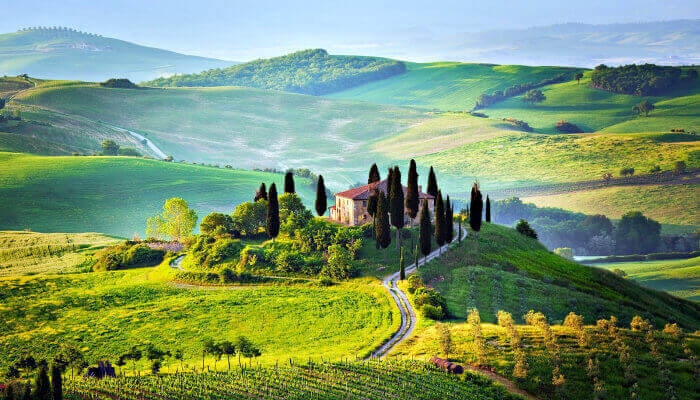
A luxuriance of olive trees, of vineyards, of cypresses and holm-oak, hills and mountains surround the city in the north, south a luxuriant valley and the lake Trasimeno, so nearby almost to serve as mirror.

Cortona can be considered a sky open museum, with its medieval and Renaissance buildings, the small and great churches, the convents and the monasteries, its narrow and risen roads. Cortona is also an alive city, proud of its past preserved with intelligence.

Other towns in the area:

Arezzo, Asciano, Badia a Ruoti, Badia Agnano, Bagni di Lucca, Barberino Val d'Elsa, Bucine, Campo nell'Elba, Camucia di Cortona, Carrara, Casciana Terme, Casole d'Elsa, Castelfiorentino, Castellina in Chianti, Castelnuovo Berardenga, Castiglion Fiorentino, Castiglioncello, Certaldo, Cetona, Chianciano Terme, Chiusi, Civitella della Chiana, Colle di Val d'Elsa, Empoli, Fabbrica di Peccioli, Figline Valdarno, Florence, Foiano della Chiana, Forte dei Marmi, Gaiole in Chianti, Gambassi Terme, Ghizzano, Grassina, Greve in Chianti, Grosseto, Iesa Palazzo, Impruneta, Lamporecchio, Laterina , Livorno, Loro Ciuffenna, Lucca, Lucignano, Marciano della Chiana, Marina di Grosseto, Empoli, Masotti, Massa, Moggiona, Molazzana, Monsummano Terme, Montaione, Montalcino, Monte San Savino, Montecatini-Terme, Montefollonico, Montelopio, Montepulciano, Monterchi, Monteriggioni, Montevarchi, Montisi, Nievole, Panzano in Chianti, Pian di Sco', Pienza, Pietrasanta, Pieve Fosciana, Pisa, Pistoia, Pitigliano, Poggibonsi, Pontassieve, Poppi, Porciano di Lamporecchio, Porciano di Stia, Pozzo della Chiana, Prato, Radda in Chianti, Radicofani, Rapolano Terme, Reggello, Rignano sull'Arno, Rigomagno, Riparbella, Rosignano Solvay, San Baronto, San Casciano dei Bagni, San Casciano in Val di Pesa, San Gimignano, San Giuliano Terme, San Miniato, San Quirico d'Orcia, Sarteano, Saturnia, Scandicci, Segromigno in Monte, Seravezza, Serre di Rapolano, Sieci, Siena, Sinalunga, Sorano, Staggia Senese, Subbiano, Tirrenia, Torre del Lago Puccini, Torrita di Siena, Trequanda, Vagliagli, Viareggio, Vinci, Volterra

You might also be interested in reading about the following Cortona topics:

Restaurants (1)
     

Bookmark and Share

Search Villas

Quick search:

Sleeps:

Min bedrooms:

From (optional):

For week(s):

Sort:

Property name:

Advanced search

(swimming pool, air conditioning, view of the sea and other amenities...)

Browse Villas

Amalfi Coast
Sorrento Coast
Tuscany
Cilento National Park
Lake Como
Rome and Latium
Umbria
Capri and Ischia
Venice
Puglia (Apulia)

Browse by town

Deals and last minute
New villas
Large groups
Luxury villas
Romantic villas

Your recently visited:

*Appartamento Ariele I, Rome
*Villa Barbara Undici, Santa Maria di Castellabate
*Villa Chiaretta B, Ischia
*Appartamento Ariele D, Rome
*Villa Saracena, Maiori
*Casa Biancamaria, Minori
*Casa Rica B, Positano
*Appartamento Ariele H, Rome
*Villa Chiaretta D, Ischia
*Villa Saveria N, Colle di Val d'Elsa, Siena
*Villa Barbara Cinque, Santa Maria di Castellabate
*Villa Gioconda, Agropoli
*Villa Saveria I, Colle di Val d'Elsa, Siena
*Casa Giobatta B, Asciano, Siena
*Casa Marina, Praiano
*Villa Chiaretta E, Ischia
*Villa Saveria O, Colle di Val d'Elsa, Siena
*Villa Roberta B, Capri
*Villa Saveria G, Colle di Val d'Elsa, Siena
*Casa Giobatta A, Asciano, Siena

How to rent

Booking on-line is easy: here is how it works and what happens after you have made your reservation.

Testimonials

Our greatest reward is your satisfaction! See what our guests think of us...

F.A.Q.

Read the answers to the most frequently asked questions on renting an apartment or a villa with us.

Let's talk

We would like to help you in choosing the best accommodation for your vacation in Italy.

About us

Learn more about us and see how we got started.

Why us?

Here are ten good reasons to book your Italian villa with us.

Terms

Read the rental terms for our properties.


Subscribe to our free newsletter to be informed of news and updates and to receive useful travel tips.

E-mail address:


Travel Guide Home

Your recently visited:


*Cortona
*Montone
*Pistoia
*Tuscany
*Nievole
*Pertosa
*Praiano
*Ravello
*Treviso
*Varenna
*Maiori
*Arezzo
*Minori
*Furore
*Naples
*Nerano
*Albori
*Bucine
*Cetara
*Bacoli

Home | Travel Guide | Travel Tips | Contact Us

USA & Canada Toll Free: 1 800 509 8194
UK Toll Free: 0 800 047 0248
International: +41 91 220 0567
Italy: +39 089 842 6126. Switzerland: +41 91 220 0567

Fax International: +41 91 220 0877. Fax Italy: +39 089 311 5055. Fax USA & Canada Toll Free: 1 888 883 7172
Email: info@summerinitaly.com

All kind of questions and suggestions are welcome: info@summerinitaly.com. Copyright © 2001-2012 Summer In Italy. All rights reserved.

USA & Canada Toll Free: 1 800 509 8194
UK Toll Free: 0 800 047 0248
International: +41 91 220 0567
Italy: +39 089 842 6126
Email: info@summerinitaly.com